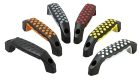


Custom Thermoset Molding Company for High-Performance Applications
Davies Molding is a U.S.-based custom thermoset molding company specializing in compression molding, transfer molding, insert molding, and engineered molded components for high-performance applications. Founded in 1933, Davies manufactures thermoset and thermoplastic components for aerospace, defense, medical, industrial, transportation, electrical, and OEM equipment manufacturers. Davies supports high-volume production programs requiring heat resistance, dimensional stability, electrical insulation, chemical resistance, and long-term durability.
Contact Davies Molding to discuss your thermoset molding requirements.
What is Thermoset Molding?
Thermoset molding is a manufacturing process that forms durable plastic components using heat and pressure. Unlike thermoplastics, thermoset materials permanently cure during molding, creating parts with high heat resistance, dimensional stability, electrical insulation, and chemical resistance.
Common Thermoset Applications
- ✓Aerospace components
- ✓Defense equipment components
- ✓Electrical insulation components
- ✓Medical equipment components
- ✓Industrial controls and handles
- ✓Transportation and automotive components
- ✓High-temperature applications
- ✓Electrical and electronic housings
- ✓Switchgear and circuit protection components
- ✓Heavy equipment and machinery components
- ✓Appliance and power equipment components
- ✓Chemical-resistant industrial parts
- ✓Precision molded OEM components
- ✓Components requiring dimensional stability and durability
Why Thermoset Molding Is Used
| Application Requirement | Why Thermoset Molding Is Used |
|---|---|
| Heat resistance | Maintains shape under high temperatures |
| Electrical insulation | Suitable for electrical applications |
| Chemical resistance | Withstands harsh environments |
| Dimensional stability | Reduces warping and creep |
| Durability | Performs in demanding industrial settings |
| High-volume manufacturing | Supports repeatable production |
| Structural integrity | Maintains strength under mechanical stress |
| Precision tolerances | Supports consistent, repeatable part dimensions |
| Long-term reliability | Performs reliably over extended service life |
| Electrical and electronic performance | Provides stable insulating properties |
| Complex molded components | Supports intricate part geometries and insert molding |
Why Choose Davies Molding?
- Founded in 1933
- U.S.-based manufacturing
- Compression, transfer, insert, and injection molding expertise
- Thermoset and thermoplastic material capabilities
- High-volume production support
- Secondary machining and assembly operations
- Engineering support for custom molded components
- Experience serving aerospace, defense, medical, industrial, and transportation industries
- ISO-certified quality systems
- Women-owned business
Contact Davies Molding to discuss your thermoset molding requirements.
Thermoset vs. Thermoplastic Molding
| Thermoset | Thermoplastic |
|---|---|
| Permanently cured | Can be remelted |
| Higher heat resistance | Greater flexibility |
| Better dimensional stability | Easier recyclability |
| Strong electrical insulation | Faster molding cycles |
Step-by-Step: The Thermoset Molding Process from an Experienced Thermoset Molding Company
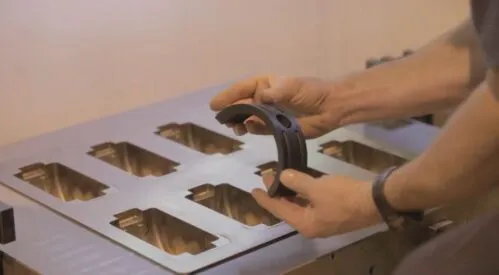
The molding process involves several key steps:
- Material Selection: The first step in thermoset molding is choosing the appropriate thermosetting resin. Common thermoset materials include epoxy, phenolic, and melamine.
- Preheating: The selected resin is preheated to a specific temperature until it becomes a liquid.
- Molding: The heated resin is injected into a mold, typically made of metal. Pressure is then applied to ensure the resin takes the shape of the mold.
- Curing: During curing, a chemical reaction occurs, transforming the liquid resin into a solid, rigid state. This process creates an irreversible, strong, heat-resistant part.
- Cooling and Ejection: After curing, the molded part is cooled, the mold is opened, and the finished product is removed.
Benefits of Thermoset Molding:
This type of molding is ideal when the following requirements must be met:
- Heat Resistance: The parts have the ability to withstand extreme temperatures without melting or becoming deformed. Industries such as defense, infrastructure, automotive, aerospace, and electrical choose thermoset molding because the part can be placed in a high-temperature area without breaking down or melting.
- Durability: The parts are exceptionally durable and resistant to wear, chemicals, and environmental factors.
- Precision: Complex shapes and tight tolerances can be achieved, ensuring precise and consistent parts.
- Electrical Insulation: Many thermoset materials offer excellent electrical insulation properties, making them suitable for electrical components.
- Cost-Effective: A thermoset molding company can provide a cost-effective option for high-volume production runs due to its efficiency and low waste.
Applications:
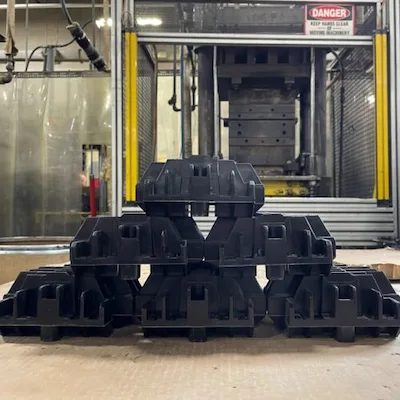
Thermoset molded company parts can be found in a wide range of industries, including:
- Automotive: Engine components, electrical connectors, and interior parts.
- Aerospace: Aircraft interiors, avionics, and structural components.
- Electrical and Electronics: Insulators, connectors, and housings.
- Appliance Manufacturing: Handles, knobs, and internal components.
- Industrial Equipment: Bearings, gears, and custom parts.
Advanced Thermoset Manufacturing Capabilities
Davies Molding supports high-volume thermoset molding programs with advanced manufacturing capabilities, large-scale production capacity, and in-house engineering expertise for demanding industrial applications.
- 45 thermoset compression molding presses for high-volume production
- 8 thermoset injection molding presses
- Press capacities ranging from 40 to 500 tons
- 100,000 sq. ft. U.S.-based manufacturing facility
- High-volume production support for OEM applications
- Secondary machining and assembly operations
- In-house engineering and tooling expertise
- Experience serving aerospace, defense, medical, industrial, and transportation industries
Contact Davies Molding to discuss your thermoset molding requirements.
As a trusted thermoset molding company, we offer compression molding services that are ideal for manufacturing parts where high performance, durability, electrical insulation, and heat resistance are critical to success.
Davies Molding has been well recognized as an expert thermoset molding company and is committed to providing top-quality products to meet your specific needs. If you're looking for precision and reliability in your plastic molded parts, trust Davies Molding’s extensive history and expertise for all your thermoset and thermoplastic molding requirements.
Come visit us and learn why we are a premier thermoset molding company and discover the benefits we offer your business. We are also recognized as a women-owned business backed by a multi-billion-dollar company. Contact us for a custom quote today to discuss your project and experience the Davies Molding difference.
Questions and Answers about Thermoset Molding
1) Greater resistance to deformation under high temperatures
2) Superior structural integrity once cured
3) Better performance in electrically insulating applications
4) Reduced material creep and warping over time
Have any questions about materials and capabilities?
Contact Us through the form below or call 1-800-554-9208.