
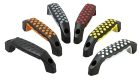



The Phenolic Advantage: High-Performance Thermoset Solutions for OEMs
Among the many various materials used to make our everyday items, from essential commodities to high-tech equipment, durable and highly versatile synthetic phenolic molding compounds are the strategic engineering choice.
Since its creation at the turn of the 20th century, generations of manufacturers have worked with phenolic-resin-based materials to create the types of items that keep the world moving. Also known as Bakelite, this type of resin is well known for its outstanding thermal resistance, dimensional stability, and electrical insulation properties.
Davies Molding introduced this groundbreaking material – the world’s first synthetic plastic – to its engineering process back in the 1940s, leaving a mark on the molding industry under the brand name “Daka-ware.” Through this brand, the company crafted handles, knobs, clamps, and more for various industries, such as automotive, electrical, and industrial.
Phenolic is created through the combination of phenol, a chemical compound derived from petroleum, with a type of aldehyde, usually formaldehyde in an alkaline environment. Resins are then made by repeatedly linking discrete molecules together to form chains and networks.
This creates a tough material that balances performance with various advantageous properties, including excellent dielectric strength, great mechanical strength, dimensional stability, resistance to high heat, wear resistance, and low moisture absorption.
In terms of general specifications, phenolic resin characteristics are determined by the physical properties, thermal properties, and electrical properties.
For physical properties, several measurements have to be taken, such as impact strength (ASTM D-256), flexural strength (ASTM D-790), tensile strength (ASTM D-651), compressive strength (ASTM D-695), and molded shrinkage (ASTM D-955).
For thermal properties, heat resistance and deflection temperature (ASTM D-648) and UL flammability (UL-94) are taken.
For electrical properties, insulation resistance (ASTM D-257), dielectric strength (ASTM D-149), volume resistivity (ASMT D-257), and arc resistance (ASTM D-495) are taken.
Understanding Phenolic Resins
Phenolic resin can be divided into two types: Novolac, a two-stage compound, and Resol, a one-stage compound. Properties of each type, like the molecular weight, monomer and moisture content, viscosity, particle size, and reactivity during curing, determine which type is suitable for the intended product and application.
Summary of the Differences Between Novolac Resins and Resole Resins
- Novolac resins are produced via acidic catalysts; resole resins are produced via alkaline catalysts.
- Novolac resins are made by pre-polymerization; resole resins are made by B-staging.
- Novolac resins are non-methylol-bearing resins; resole resins are methylol-bearing resins.
- Novolacs have an infinite shelf life; resoles have a typical shelf life of less than 1 year (less than 60 days).
- Novolacs give off ammonia when they cure; resoles split off water when they cure.
- Novolac resins are twice as dimensionally stable as resoles.
- Resoles are typically casting and bonding resins; molding compounds are made from novolacs.
- Novolacs are solids; resoles are usually liquids.
Overview of Phenolic Novolac Resins
Novolac resins are made by reacting phenol with formaldehyde in the presence of an acidic catalyst, using more phenol than formaldehyde. This reaction forms methylene bridges between phenol rings at either the ortho or para positions, resulting in a random, highly branched structure. The reaction stops when formaldehyde runs out, often leaving some unreacted phenol, which is removed during manufacturing.
These resins don’t cure on their own and require a cross-linking agent, typically hexamethylenetetramine (hexa), to form a solid, heat-resistant material. When heated, hexa releases formaldehyde and links the resin molecules into a strong three-dimensional network. This makes novolac resins hard, heat-resistant, and solvent-resistant.
Some catalysts can influence the way the resin forms, potentially speeding up the curing process. Novolac resins are thermoplastic, which means that they’re solid at room temperature but melt and flow between 150-220°F (65-105°C). They’re not water-soluble but dissolve in many polar organic solvents. Their molecular size typically ranges from chains of about five linked phenol rings.
Overview of Phenolic Resol Resins
Resol resins are made using a basic (alkaline) catalyst and typically an excess of formaldehyde. In the first step, phenol reacts with formaldehyde to form methylol phenol, which can then react further to create longer chains, dibenzyl ether links, or methylene bridges. Because excess formaldehyde leaves enough reactive groups, resol resins can cure on their own without added curing agents, earning them the name “single-stage” or “one-step” resins.
During manufacturing, the reaction is carefully controlled, then cooled quickly to stop further polymerization. However, resol resins continue to slowly cure over time, giving them a limited shelf life depending on storage and formulation.
By adjusting various reaction factors (like pH, time, and temperature), manufacturers can tailor resol resins for different properties. They typically have a molecular weight between 200 and 450 and are available as liquids (with varying viscosities), granules, powders, or lumps. Most resol resins are at least partially water-soluble.
Key Characteristics of Phenolic Novolac Resins:
- Reinforced with carbon fiber, glass fiber, organic filler, or inorganic filler.
- Excellent heat resistance, mechanical strength, and electrical properties.
- Lower formaldehyde content; requires a curing agent.
- Need hexamethylenetetramine to properly cure.
- Feature a higher processing temperature.
- Generally used for high-precision components.
Key Characteristics of Phenolic Resol Resins:
- Reinforced with glass fiber, organic filler, or inorganic filler.
- Based on non-ammonia grades.
- Extremely low metal corrosion and excellent electrical properties.
- Cure with heat alone.
- Feature a lower processing temperature.
- Generally used for general-purpose electrical parts.
Design and Processing Considerations
Phenolic resins expand and cure at a rapid rate under heat and pressure, which makes mold design critical. Tooling must accommodate for shrinkage, venting, pressure during processing, and part ejection.
Precision venting is essential as it prevents gas entrapment, which could otherwise cause surface defects or voids. During the manufacturing process, proper draft angles must be incorporated to assist with part ejection, and molds should be built with hardened steel due to the abrasive nature of filled phenolic compounds.
Phenolic components can be molded through two primary methods: Compression Molding and Injection Molding.
Compression molding is ideal for larger parts or when using fiber-reinforced or glass-reinforced phenolics. Uniform pressure distribution occurs, which is cost-effective for low- to medium-volume runs. The process involves placing preheated material into an open mold cavity, then closing the mold to form the part under heat and pressure.
Injection molding is best suited for high-volume production of complex or highly detailed parts. The compounds are fed into a heated barrel and injected into a closed mold. Special considerations such as screw design, mold temperature control, and gate placement are critical for maintaining flow and preventing premature curing in the machine.
Some post-molding may be required. This may include deflashing, machining, drilling, tapping, or threading to meet tight tolerances or functional assembly requirements. Phenolic materials are dimensionally stable and machinable but require proper fixturing and tooling due to their hardness and brittleness.
Key Properties of Phenolic Molding Compounds
Thermal Resistance: Phenolic parts have high heat resistance. They maintain mechanical integrity and dimensional stability at temperatures exceeding 250°C (482°F), making them ideal for under-the-hood automotive applications and electrical components exposed to heat or thermal stress.
Mechanical Strength and Durability: Phenolic materials exhibit high compressive strength, hardness, resilience, and creep resistance. They’re suitable for creating long-lasting parts that can endure high impact, heavy loads, harsh environments, and impact stresses, particularly when reinforced with other fibers or fillers.
Moldability: Phenolic is a highly moldable compound that can be morphed into complex shapes and textures with minimal shrinkage. It’s ideal for mass productions of consistent, high-performance parts.
Electrical Insulation: With a high dielectric strength and low arc-tracking index, phenolic compounds are well suited for electrical insulation. The material effectively prevents electrical currents from flowing through the molded component, enhancing safety and reliability. They are commonly used in terminal blocks, circuit breakers, and switchgear.
Chemical Resistance: Phenolic components resist a broad range of chemicals, including oils, fuels, greases, alkalis, and many acids and solvents. This makes them ideal for industrial and automotive environments and other situations where the material is often exposed to a wide range of substances without degrading or eroding.
Dimensional Stability: Due to their low thermal expansion and moisture absorption, phenolic parts retain tight tolerances over a wide temperature range. This is especially important in assemblies requiring exact fits and repeatability.
Cost-Effectiveness: This type of material provides the ideal balance between performance and cost efficiency. It’s often readily available and in demand due to its desirable characteristics.
Phenolic Components Found Across Industries and Applications
From electrical components and automotive parts to kitchenware and consumer goods, phenolic material plays a pivotal role in shaping the items we rely on every day.
Automotive: Thermal resistance and mechanical strength make them suitable for demanding engine bay conditions:
- Ignition components
- Valve parts
- Heat shields
- Brake components
- Distributor caps
- Engine gaskets
Electrical & Electronics: Phenolics are a go-to material for electrical insulation:
- Terminal boards
- Light switch housings
- Coil forms
- Circuit breaker housings
- Insulators
- Circuit boards
- Connectors
- Switchgear
Industrial Equipment: Durability, heat resistance, and aesthetic finish make them suitable for frequent human interaction in rugged environments:
- Knobs
- Handles
- Control panels
- Pumps
- Valves
- Bearings
- Gears
- Wear-Resistant components
Consumer Goods: Heat-resistant and non-conductive properties make it ideal for frequently used appliances:
- Stovetop appliance knobs
- Cookware handles
- Hair styling tools
- Kitchenware
- Utensils
- Appliance components
Aerospace & Defense: Lightweight and fire-resistant characteristics improve component performances:
- Aircraft interior panels
- Electrical housings
- Non-structural components
- Seat backs
- Cabin panels
- Overhead bins
Marine: Moisture resistance, electrical insulation, and durability greatly benefit saltwater-associated applications:
- Structural laminates
- Marine-grade plywood
- Insulation materials
- Ablative coatings
- High-pressure laminate panels
Medical: Best for components requiring chemical resistance, sterilizability, and long-term dimensional stability:
- Diagnostic equipment housings
- Sterilization trays and components
- Instrument handles
- Medical-grade laminates
Oil & Gas: Thermal stability, flame resistance, and chemical durability are prominent features for these components:
- Wellhead seals and insulators
- Drill bit components and tool handles
- Pipeline coatings
- Fracturing plugs and bridge plugs
- Electrical insulators and connectors
Comparing Phenolic vs. Other Synthetic Thermoset Materials
| Property/Characteristics | Phenolic (Thermoset) | Polyester (BMC/SMC) (Thermoset) | Epoxy (Thermoset) |
|---|---|---|---|
| Thermal Resistance | Excellent (>250°C) | Good (up to 180°C) | Excellent (150-180°C) |
| Electrical Insulation | Excellent | Very Good | Excellent |
| Mechanical Strength | High (brittle) | High | High |
| Impact Resistance | Moderate | Good | Excellent |
| Dimensional Stability | Excellent | Very Good | Very Good |
| Chemical Resistance | Excellent (oils, acids) | Good | Excellent |
| Water Absorption | Very Low | Low | Low |
| Flame Resistance | Excellent (self-extinguish) | Good | Excellent |
| Machinability/Secondary Ops | Excellent (can drill/tap) | Excellent | Good |
| Recyclability | Not Recyclable | Not Recyclable | Not Recyclable |
| Mold Shrinkage | Very Low (0.001-0.003 in/in) | Low | Low |
| Cost per Part | Moderate | Moderate | High |
| Processing Type | Thermoset Molding | Compression/Injection | Casting/Transfer |
Though polyester is often used in bulk/SMC parts, it has a lower heat tolerance compared to phenolic. On the other hand, epoxies have excellent adhesive and thermal properties but are often more expensive and harder to process in larger volumes.
Here, phenolic stands out for its balance of cost, heat resistance, electrical insulation, and moldability. This makes phenolic the ideal choice for electrical insulations in high-voltage environments, precision molding with dimensional stability, and high-volume production with low mold shrinkage.
Comparing Phenolic vs. Other Synthetic Thermoplastic Materials
| Property/Characteristics | Phenolic (Thermoset) | Nylon (PA) (Thermoplastic) | ABS (Thermoplastic) | Polycarbonate (PC) (Thermoplastic) |
|---|---|---|---|---|
| Thermal Resistance | Excellent (>250°C) | Moderate (90-120°C) | Poor (<90°C) | Good (130-150°C) |
| Electrical Insulation | Excellent | Good | Moderate | Good |
| Mechanical Strength | High (brittle) | High (tough) | Moderate | High (impact-resistant) |
| Impact Resistance | Moderate | High | High | Excellent |
| Dimensional Stability | Excellent | Moderate | Poor | Good |
| Chemical Resistance | Excellent (oils, acids) | Moderate | Poor | Moderate |
| Water Absorption | Very Low | High | Moderate | Moderate |
| Flame Resistance | Excellent (self-extinguish) | Poor (additives needed) | Poor | Fair (additives needed) |
| Machinability/Secondary Ops | Excellent (can drill/tap) | Moderate | Good | Moderate |
| Recyclability | Not recyclable | Fully recyclable | Fully recyclable | Fully recyclable |
| Mold Shrinkage | Very Low (0.001-0.003 in/in) | Moderate | High | Moderate |
| Cost per Part | Moderate | Moderate | Low | High |
| Processing Type | Thermoset Molding | Injection Molding | Injection Molding | Injection Molding |
Now, compared to thermoplastics like Nylon and ABS, phenolic compounds offer much higher heat resistance and chemical durability. On the other hand, thermoplastics offer toughness and recyclability, but they’re generally limited under high-temperature or electrical conditions.
Davies Molding Phenolic Capabilities
During its revolution in the mid-19th century, Davies Molding’s Daka-ware brand became synonymous with the reliability and precision of phenolic-based products. As a leading expert in thermoset molding compounds, Davies Molding offers deep expertise in phenolic resins, including but not limited to:
- Custom Molding Services: Injection and compression molding tailored to client designs.
- Engineering Support: Design consultation, mold flow analysis, and material selection guidance.
- Secondary Operations: Drilling, tapping, pad printing, and assembly.
- Other Material Options: Phenolic, DMC, polyester, melamine, urea, and more.
Davies Molding’s in-house tooling capabilities and commitment to quality ensure repeatable high-performance results. It serves customers across the appliance, electrical, automotive, industrial, aerospace, marine, medical, and oil and gas sectors.
For OEMs and engineers seeking a long-term solution that performs reliably in extreme environments, phenolic resins should be a material of choice. With decades of experience, comprehensive capabilities, and a customer-first approach, Davies Molding is your ideal partner for phenolic molded components.